

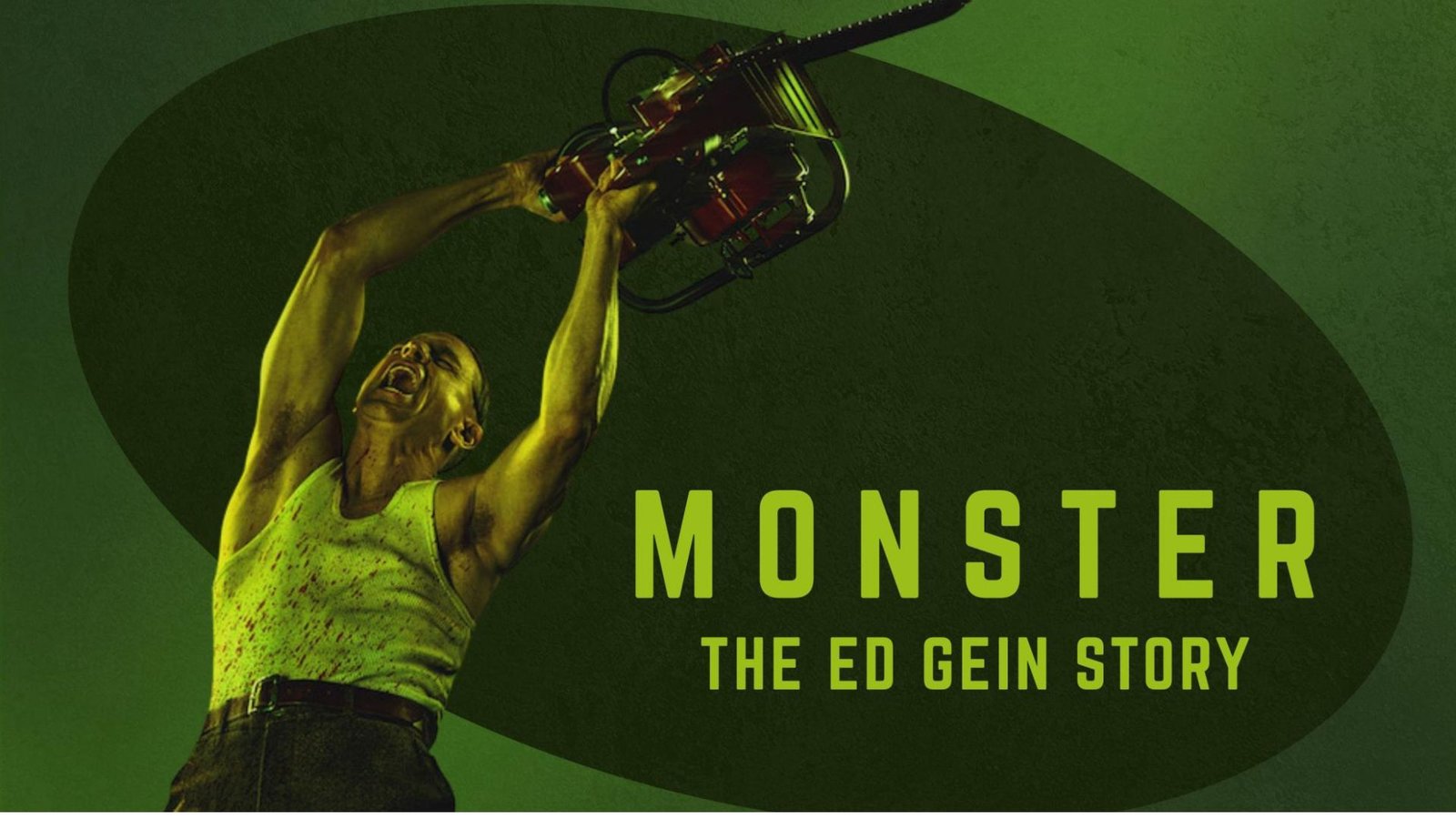
If you are searching for Monster the Ed Gein Story, you are probably trying to answer more than one question: How closely does the Netflix series follow the real case? Who plays the major characters? And are the reviews as disturbing as the subject itself? The third season of Ryan Murphy and Ian Brennan’s Monster anthology tackles Ed Gein, the Wisconsin murderer and grave robber whose crimes became part of horror history. The eight-episode season premiered on Netflix on October 3, 2025.
The series is particularly unusual because it is not simply a reconstruction of a 1950s murder investigation. It also examines how Gein’s crimes influenced popular horror, including Psycho, The Texas Chain Saw Massacre, and The Silence of the Lambs. That broader idea helps explain both the show’s ambitions and the sharply divided response from critics.
This guide covers the Monster the Ed Gein Story cast, the real Ed Gein case, what the series changes or dramatizes, and what reviewers have said about the finished season.
What Is Monster: The Ed Gein Story About?
Monster: The Ed Gein Story is the third installment of Netflix’s Monster anthology. Unlike a conventional fictional horror series, it is based on a real criminal case and dramatizes the life of Edward Theodore Gein, who lived near Plainfield, Wisconsin.
The story focuses heavily on Gein’s isolated existence, his relationship with his mother Augusta, his disturbing fixation with death, and the crimes eventually uncovered by investigators.
Netflix describes the series as a story about the murderer and grave robber whose actions influenced some of Hollywood’s most recognizable horror villains. All eight episodes are available on Netflix.
There is also a second layer to the storytelling. The show connects Gein to the fictional and cinematic monsters that followed him. That means viewers are watching both a historical crime drama and a commentary on the way true crime becomes entertainment.
That distinction matters because some viewers expecting a straightforward biography may find the structure surprisingly meta.
Monster the Ed Gein Story Cast
The central performance comes from Charlie Hunnam, who plays Ed Gein. The ensemble includes established actors and several performers playing real historical figures connected either to Gein or to the later cultural history surrounding his crimes.
| Actor | Character | Role in the Story |
|---|---|---|
| Charlie Hunnam | Ed Gein | The central figure |
| Laurie Metcalf | Augusta Gein | Ed’s mother |
| Suzanna Son | Adeline Watkins | Gein’s acquaintance and friend |
| Tom Hollander | Alfred Hitchcock | Filmmaker associated with Psycho |
| Olivia Williams | Alma Reville | Hitchcock’s wife and creative collaborator |
| Joey Pollari | Anthony Perkins | Actor who played Norman Bates |
| Lesley Manville | Bernice Worden | Gein’s confirmed murder victim |
| Charlie Hall | Deputy Frank Worden | Bernice Worden’s son |
| Tyler Jacob Moore | Sheriff Schley | Law-enforcement figure |
| Vicky Krieps | Ilse Koch | Historical figure incorporated into the series |
| Will Brill | Tobe Hooper | Director associated with The Texas Chain Saw Massacre |
| Addison Rae | Evelyn | A babysitter connected to the story |
Netflix’s official cast guide confirms the major roles and emphasizes that the season expands beyond Gein himself into the people and cultural figures connected to his legacy.
Charlie Hunnam as Ed Gein
Hunnam’s transformation is one of the most discussed aspects of the production.
Rather than simply copying Gein’s physical appearance, Hunnam researched his subject extensively. He said he lost almost 30 pounds to create a thinner physical frame and studied Gein’s mannerisms, posture and voice.
One particularly interesting detail is that Hunnam accessed a recording of Gein made shortly after his 1957 arrest. According to Hunnam, listening to Gein directly helped him understand his speech patterns, inflection and word choices rather than relying entirely on sensationalized secondary accounts.
That research choice is significant because the popular image of Gein has been shaped by decades of horror fiction.
Laurie Metcalf as Augusta Gein
Laurie Metcalf plays Augusta, Gein’s mother, and the mother-son relationship is central to the show’s early episodes.
The series portrays Augusta as a deeply controlling and religious presence in Ed’s life. The psychological consequences of that relationship become one of the show’s primary explanations for his isolation and later behavior.
However, this is also where some criticism of the series begins. Several critics argued that the mother-son relationship introduced at the beginning is not developed consistently throughout the season. Variety’s review specifically criticized the series for losing focus on Augusta after establishing her importance early on.
The Real Ed Gein Story Explained
The real case is disturbing, but it is also important to separate confirmed facts from myths that accumulated around Gein over the decades.
Edward Theodore Gein was born in Wisconsin in 1906 and eventually lived on a farm outside Plainfield. He became increasingly isolated following the deaths of members of his immediate family, particularly his mother Augusta in 1945.
Gein confessed to killing two women: Mary Hogan, who disappeared in 1954, and Bernice Worden, whose disappearance in November 1957 led investigators to his property. He was ultimately convicted of Worden’s murder.
The investigation uncovered evidence that Gein had also robbed graves and removed human remains. The Wisconsin Historical Society records that he was believed to have robbed graves in local cemeteries and used human remains to create various objects.
This creates an important distinction when discussing his reputation.
Gein’s confirmed murder count is two, although he has frequently been described in popular culture as a serial killer. Definitions of serial murder vary, and some commonly used definitions require at least three victims while others use two.
That is one of the less obvious facts about the case: Gein’s enormous cultural influence does not correspond to a huge number of confirmed murders. His notoriety came from the extraordinary nature of the crimes, the grave robbing, the objects discovered at his property, and the later influence his case had on horror fiction.
How Did Ed Gein Influence Horror Movies?
This is where Monster takes a broader approach than a normal true-crime drama.
Gein became an important source of inspiration for several fictional horror characters. The Wisconsin Historical Society identifies Psycho, The Silence of the Lambs, and The Texas Chain Saw Massacre among works thought to have drawn inspiration from the case.
However, the fictional characters are not direct copies of Gein.
For example, Norman Bates in Psycho is not a literal recreation of Gein’s life. The Texas killer Leatherface is similarly a fictional creation rather than a biography of Gein.
The connection is better understood as a collection of ideas and imagery entering popular culture:
- An isolated rural killer.
- A disturbing relationship with a dead or controlling mother.
- Grave robbing and fascination with corpses.
- The use of human remains in disturbing ways.
- The contrast between an apparently ordinary person and horrific private behavior.
This distinction is important because saying that Gein “was” Norman Bates or Leatherface oversimplifies the historical record.
What Makes the Netflix Series Different?
The unusual feature of this season is its attempt to examine the afterlife of a crime story.
Instead of ending the story when Gein is arrested, the series explores how his case became part of American horror culture.
That approach creates some interesting moments, but it also makes the season structurally complicated.
1. It is partly a story about true crime itself
The show asks why audiences remain fascinated by people like Gein.
That question is not completely separate from the Netflix series itself. The production places the viewer in the uncomfortable position of consuming a dramatized version of a real person’s crimes while simultaneously asking why people consume such stories.
2. Historical figures become part of the narrative
The inclusion of Alfred Hitchcock, Anthony Perkins and Tobe Hooper allows the show to connect Gein’s crimes with later horror filmmaking.
Netflix’s cast information confirms these characters are deliberately part of the season’s broader exploration of Gein’s cultural legacy.
3. It deliberately mixes historical reality and dramatization
Viewers should not treat every conversation or event in the eight episodes as a documented historical occurrence.
The creators use dramatization to explore psychological and cultural themes. That is normal for a scripted historical drama, but it becomes particularly important when the subject involves real victims and real crimes.
Monster the Ed Gein Story Reviews: What Critics Are Saying
The critical response has been notably divided, with the overall professional reception leaning negative.
Rotten Tomatoes currently lists the season at 22% from 41 critic reviews, while its audience score is 49% from more than 1,000 ratings. These numbers can change as additional ratings are submitted.
Metacritic lists a 28/100 score based on 15 critics for Season 3, categorized as “Generally Unfavorable.”
What critics praised
Not every review was negative.
Some critics highlighted the performances, production design and the show’s attempt to connect Gein with the history of horror cinema. The Boston Globe, for example, gave the season a positive assessment and praised its creative combination of Gein’s story with the fictional monsters he influenced. Decider also gave the season a favorable review, noting its effectiveness in introducing Gein’s historical importance to audiences unfamiliar with the case.
Charlie Hunnam’s performance is another recurring point of interest, even among less enthusiastic reviews.
What critics criticized
The biggest criticism concerns tone and focus.
Several reviewers argued that the series spends too much time on gruesome material without developing a sufficiently coherent argument about it. Variety criticized the lack of a central focus, while The Guardian argued that the show becomes overly voyeuristic.
Another criticism concerns the number of storylines. By moving between Gein, his victims, Hollywood figures and other historical material, the season sometimes sacrifices narrative concentration.
That helps explain why two viewers can watch the same eight episodes and come away with very different reactions: one may see an ambitious examination of true crime and horror culture, while another may see an unfocused dramatization that spends too much time on sensational material.
3 Things You May Miss on a First Watch
The “serial killer” label needs context
Gein’s cultural status can make his confirmed crime record easy to misunderstand. He confessed to two murders and was convicted of Worden’s murder; the grave-robbing evidence was a major part of the case’s notoriety.
The horror connection is bigger than Psycho
Many people discover Gein through Psycho, but his influence is usually discussed alongside The Texas Chain Saw Massacre and The Silence of the Lambs. None of those movies is simply a factual retelling of his life.
Hunnam’s performance was built from primary evidence
The actor’s use of an actual post-arrest recording is a particularly unusual piece of preparation. It gives his vocal performance a historical reference point that goes beyond simply watching old photographs or reading popular biographies.
Is Monster: The Ed Gein Story Based on a True Story?
Yes. The series is based on the real life of Ed Gein and his crimes in Wisconsin. Netflix says Gein was active in the Plainfield area from 1947 to 1957 and that the season examines both his crimes and their influence on popular culture.
However, the series is a scripted dramatization rather than a documentary. Some scenes, dialogue, relationships and transitions are constructed for dramatic purposes, so viewers should distinguish established historical facts from the show’s interpretation.
How Many Episodes Are in Monster: The Ed Gein Story?
There are eight episodes in the season. Netflix lists the series as a TV-MA drama and identifies it as a crime, horror and historical series based on real life.
The episodes generally run from roughly 45 minutes to just over an hour, making the season suitable for viewers who prefer a limited-series format rather than a long-running procedural.
Frequently Asked Questions
Who plays Ed Gein in Monster: The Ed Gein Story?
Charlie Hunnam plays Ed Gein. He underwent a significant physical transformation for the role and researched Gein extensively, including listening to a recording made after Gein’s arrest.
Who plays Ed Gein’s mother in Monster?
Laurie Metcalf plays Augusta Gein. The character is especially important during the early part of the season because the complicated mother-son relationship is central to the show’s portrayal of Gein’s development.
Is Monster: The Ed Gein Story accurate?
It is based on real events but is not a documentary. The murders, arrest and discovery of evidence at Gein’s property are grounded in the historical case, while some dialogue, relationships and dramatic sequences are necessarily reconstructed or interpreted.
How many people did Ed Gein actually kill?
Gein confessed to killing two women, Mary Hogan and Bernice Worden. He was convicted of Worden’s murder, while his grave robbing and treatment of human remains became another major part of the case.
Why is Ed Gein famous in horror history?
Gein’s crimes became a major influence on horror culture, particularly through connections commonly drawn to Psycho, The Texas Chain Saw Massacre, and The Silence of the Lambs. The connection is one of inspiration rather than direct biographical adaptation.
Key Takeaway
Monster: The Ed Gein Story is more than a conventional retelling of a notorious Wisconsin crime. Its eight episodes combine Gein’s biography with an examination of how his crimes entered the mythology of American horror. Charlie Hunnam leads a large cast that includes Laurie Metcalf, Suzanna Son, Tom Hollander, Olivia Williams, Lesley Manville and Joey Pollari.
The reviews reveal the season’s central tension: some critics appreciate its performances and ambitious examination of horror culture, while others argue that its graphic material, multiple storylines and sensational approach undermine that ambition.
For viewers interested in the real case, the most useful approach is to treat the series as historical drama inspired by documented events, not as a complete factual record. That distinction makes it easier to understand both what Monster is trying to say and why its interpretation has generated such a strong reaction.
