

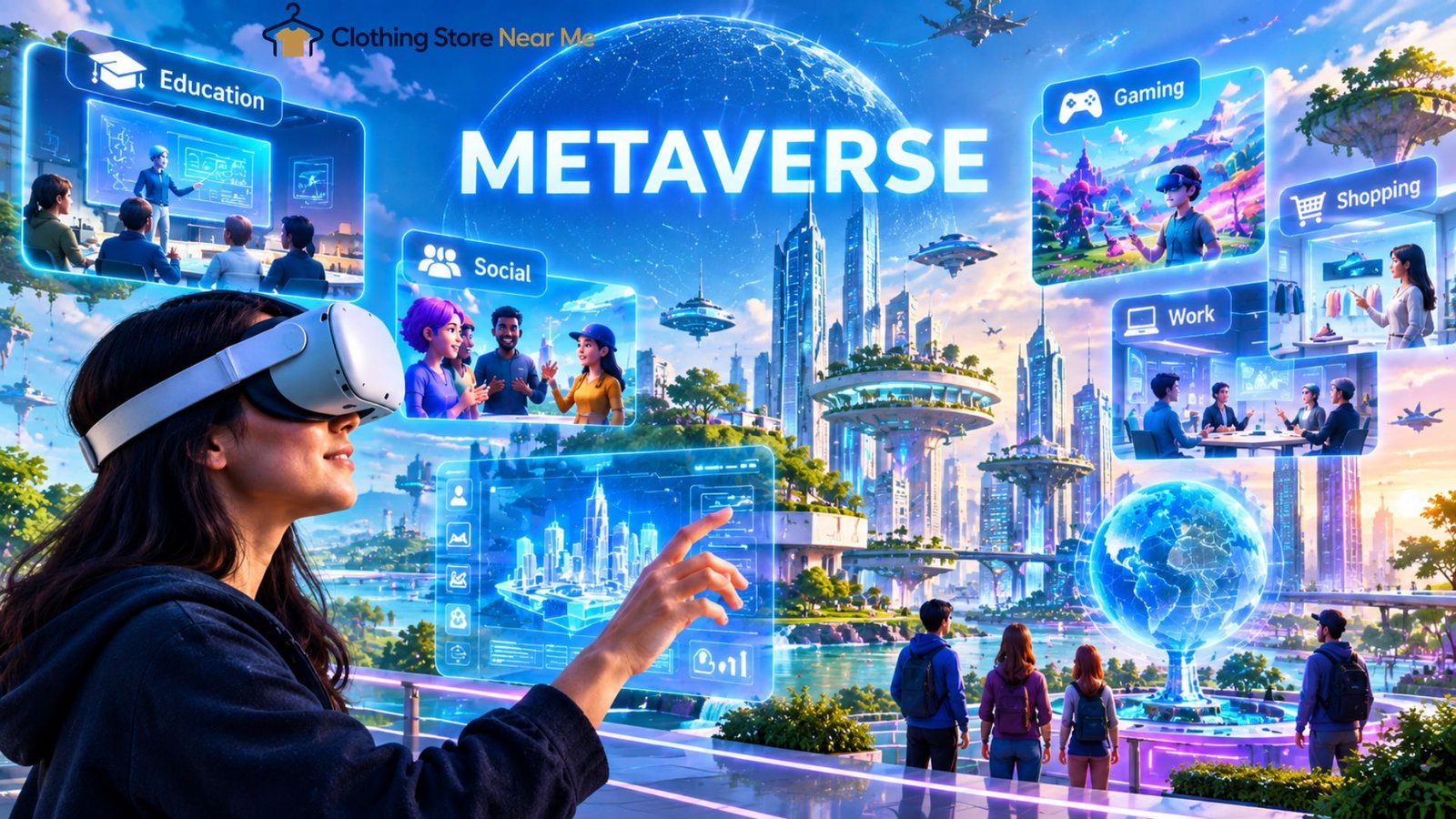
The metaverse refers broadly to interconnected or persistent digital environments where people can interact through avatars, communicate, work, play, learn, shop, and create. It is not a single website or one piece of software. Instead, the idea brings together technologies such as virtual reality (VR), augmented reality (AR), 3D graphics, artificial intelligence, cloud computing, digital identity, and online social platforms.
The concept has attracted attention because immersive technology can make digital interaction feel more physical. NIST notes that immersive technologies already have potential applications beyond entertainment, including education, manufacturing, accessibility, workforce training, healthcare, and retail.
Understanding the technology requires separating the long-term vision from products that exist today.
What Is the Metaverse?
At its simplest, the metaverse is a vision of online spaces that feel more like places than conventional webpages or apps. Users may appear as avatars, communicate in real time, explore digital environments, attend events, collaborate on projects, or interact with virtual objects.
Virtual worlds have existed for years, but newer platforms combine them with immersive hardware and other emerging technologies. The Federal Trade Commission has described virtual worlds as environments where users represented by avatars can socialize, network, play, and conduct business.
There is also no single universally accepted definition. The term can describe everything from social VR platforms to enterprise simulations and broader visions of a persistent digital economy.
That distinction matters because not every VR game, virtual meeting room, or online 3D space is automatically part of one unified metaverse.
How Does the Metaverse Work?
Several technologies contribute to the experience.
Virtual and Augmented Reality
VR headsets can place users inside computer-generated environments, while AR overlays digital information onto the physical world. Mixed-reality systems can blend virtual objects with real surroundings.
These interfaces make digital experiences more immersive than conventional screens. A learner might examine a simulated machine, for example, while an employee could practice a procedure in a controlled virtual environment.
3D Content and Real-Time Interaction
Three-dimensional models create the environments, objects, and avatars users encounter. Real-time networking allows people to communicate and respond to events together.
This combination is particularly useful for collaboration because participants can interact with shared virtual spaces rather than simply exchanging text or video.
Cloud Computing and Connectivity
Immersive applications can require substantial computing power and data transmission. Cloud infrastructure can help deliver graphics, services, storage, and multiplayer functionality while connected devices provide the interface.
Reliable connectivity therefore becomes an important part of the experience, especially for applications requiring low latency.
Digital Identity and Virtual Assets
Digital environments need ways to represent users, accounts, permissions, and sometimes ownership. Some projects also use blockchain and tokens to represent digital assets.
However, blockchain is not a requirement for every metaverse application. NIST’s discussion of Web3 distinguishes the broader decentralized-internet concept from the technologies used to implement it, while also highlighting emerging security and privacy concerns.
Where Is the Metaverse Being Used?
The strongest applications are not necessarily entertainment products. Businesses and institutions can use immersive environments when spatial interaction provides an advantage.
| Area | Potential Use | Main Advantage |
|---|---|---|
| Education | Virtual classrooms, simulations, 3D demonstrations | Experiential learning |
| Healthcare | Training and controlled simulations | Practice without real-world exposure |
| Manufacturing | Digital twins and workforce training | Visualization and safer testing |
| Retail | Virtual showrooms and product experiences | Interactive product discovery |
| Workplace | Virtual meetings and collaboration | Shared 3D environments |
| Entertainment | Games, concerts, social spaces | Immersive participation |
Digital twins are another related area. NIST describes them as electronic representations of real-world or non-physical entities and emphasizes the importance of interoperable definitions, tools, and standards for their development.
💡 Pro Tip
If you are evaluating a metaverse project for a business, begin with the problem rather than the technology. Ask whether a 3D or immersive experience genuinely improves training, visualization, collaboration, customer engagement, or another measurable task. If a conventional website or video works just as well, adding immersive technology may increase complexity without adding meaningful value.
What Are the Potential Benefits?
One major advantage is presence. A video call can show several people on a screen, while an immersive environment can give participants a shared sense of location and spatial interaction.
Training is another promising application. Employees can rehearse procedures, explore equipment, or practice scenarios without immediately exposing themselves to real-world consequences.
Accessibility may also improve in certain situations. Digital environments can potentially provide alternative ways to communicate, learn, or participate, although accessibility depends heavily on the design of each platform and device.
For companies, virtual environments may also create new ways to demonstrate products, host events, collaborate with distributed teams, and experiment with digital services.
What Are the Risks and Limitations?
The technology has significant challenges.
Privacy and Data Collection
Immersive systems can involve more than conventional account information. Depending on the hardware and application, interactions may involve movement, voice, behavioral signals, or other information.
NIST’s recent work on immersive technologies specifically addresses cybersecurity and privacy concerns, showing that these issues are central rather than secondary considerations.
Security
Accounts, virtual assets, connected devices, and cloud services can all create potential attack surfaces. Strong authentication, secure software design, appropriate access controls, and careful data handling are therefore essential.
Interoperability
A major long-term question is whether users and their digital assets can move easily between different platforms. Interoperability means systems can communicate with one another, but achieving it across competing virtual environments requires compatible technical standards and business incentives.
Cost and Hardware
High-quality immersive experiences may require specialized hardware, capable computers, sufficient bandwidth, and comfortable physical spaces. These requirements can limit adoption compared with ordinary web applications.
User Safety
Social virtual environments can also create moderation challenges. The FTC has previously documented privacy and safety concerns involving children in online virtual worlds, including inappropriate content and improper collection or disclosure of children’s personal information.
Is the Metaverse the Future of the Internet?
It may influence the future of online interaction, but it is unlikely to replace the entire internet in one step.
The more realistic direction is a gradual expansion of immersive experiences alongside existing websites, mobile apps, video platforms, games, and communication tools. Some activities will benefit from 3D interaction, while others will remain faster and more convenient on a traditional screen.
The future may therefore be less about entering one giant virtual universe and more about using different immersive environments when they provide genuine practical value.
📌 Key Takeaway
The metaverse is best understood as an evolving collection of technologies and experiences rather than a finished product. Its long-term value will depend on useful applications, affordable hardware, privacy protections, security, accessibility, and interoperability—not simply on how realistic a virtual world looks.
Frequently Asked Questions
Is the metaverse a real thing?
Yes, but not as one unified virtual world. Virtual worlds, VR applications, AR experiences, social platforms, simulations, and enterprise environments already exist. The broader idea describes how these technologies could develop into richer, more persistent forms of digital interaction.
Do you need a VR headset to access the metaverse?
No. Some immersive environments are designed for VR headsets, but others can be accessed through computers, smartphones, tablets, or other devices. The required hardware depends on the particular platform and the type of experience it provides.
Is cryptocurrency required for the metaverse?
No. Cryptocurrency or blockchain technology may be used by some platforms for payments, digital assets, or decentralized applications, but they are not fundamental requirements for creating a virtual environment. Many immersive applications operate without blockchain-based ownership or cryptocurrency.
What is the difference between VR and the metaverse?
VR is a technology and interface that can place users inside a simulated environment. The metaverse is a broader concept involving persistent digital spaces, social interaction, digital identities, virtual objects, and connected experiences. VR can be part of the metaverse, but the two terms are not interchangeable.
Will the metaverse replace social media?
There is no evidence that it will completely replace conventional social media. Instead, immersive platforms may become another way people communicate and share experiences. Text, photos, video, and traditional social networks are likely to remain useful because they are accessible and convenient across a wide range of devices.
Conclusion
The metaverse remains an evolving idea rather than a finished destination. Its most credible opportunities are emerging where immersive technology solves a specific problem—such as training, education, product visualization, collaboration, simulation, or interactive entertainment.
The biggest challenges are equally practical: privacy, cybersecurity, accessibility, hardware costs, content moderation, and interoperability. As those issues receive more attention, the technology is likely to become easier to evaluate on practical outcomes rather than hype.
For users and businesses, the smartest approach is to focus on what an immersive environment enables that existing digital tools cannot do as effectively. That practical test will ultimately determine where the metaverse earns a lasting place in everyday digital life.
