

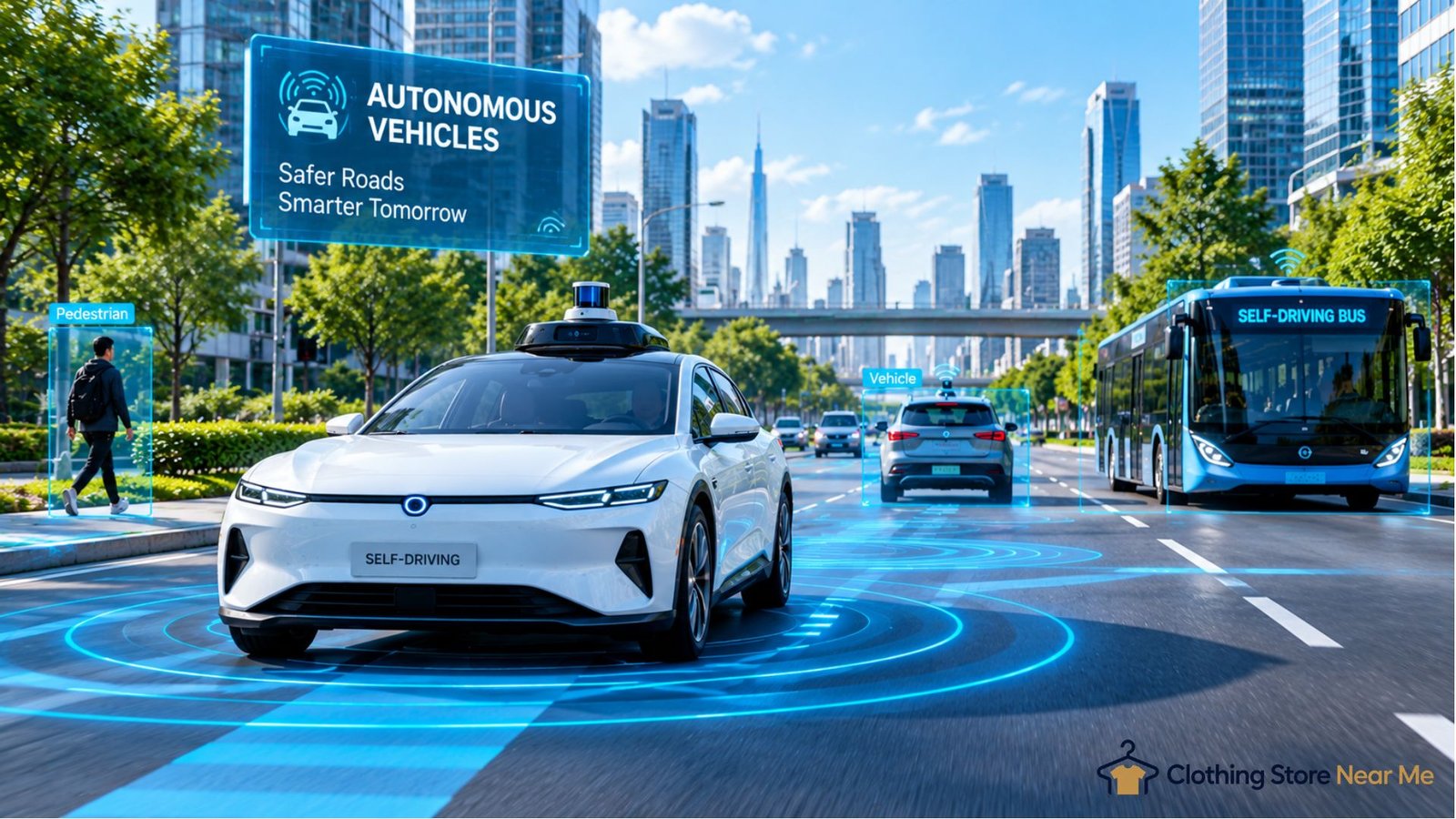
Autonomous vehicles represent one of the most transformative transportation technologies of the 21st century. These self-driving cars combine advanced sensors, artificial intelligence, and real-time data processing to navigate roads with minimal or no human intervention. While fully autonomous vehicles remain limited to specific testing zones, the technology is advancing rapidly across the USA and UK.lemonade+1
This article explains how autonomous vehicles actually work, examines their potential benefits and current limitations, and outlines what consumers and businesses need to know about the state of self-driving technology in 2026.
How Autonomous Vehicles Work
Self-driving cars operate through a continuous cycle of perception, planning, and control. The vehicle constantly scans its environment, interprets what it detects, predicts how other road users will behave, and then executes driving decisions.neuralconcept+1
Sensor Technology
Modern autonomous vehicles rely on a sophisticated fusion of sensors to perceive their surroundings:
- Cameras capture visual information like traffic lights, road signs, lane markings, and pedestrians. They function similarly to human eyes but process images far faster.lemonade+1
- LiDAR (Light Detection and Ranging) fires millions of laser pulses per second to create precise 3D maps of the environment. This technology excels at measuring distances and detecting object shapes.roboticsandautomationnews+1
- Radar uses radio waves to detect the speed and distance of nearby objects. It performs reliably in adverse weather conditions where cameras may struggle.lemonade+1
- GPS and mapping systems provide localization data and detailed roadway information, including lane configurations and traffic patterns.lemonade
These sensors feed data into powerful onboard computers running artificial intelligence and neural networks. The systems process thousands of calculations per second to identify objects, predict movements, plan safe routes, and control steering, acceleration, and braking.lemonade+1
| Sensor Type | Primary Function | Best Use Case | Key Weakness |
|---|---|---|---|
| Cameras | Visual recognition | Reading signs, detecting colors | Struggles in low light or bad weather |
| LiDAR | 3D mapping | Precise distance measurement | Expensive, affected by heavy rain or snow |
| Radar | Motion detection | Measuring speed in all weather | Lower resolution than LiDAR |
| GPS | Localization | Route planning and positioning | Signal loss in tunnels or urban canyons |
💡 Pro Tip:
When evaluating autonomous vehicle claims, look for specific automation levels. Most vehicles marketed as “self-driving” today operate at Level 2 automation, requiring active driver supervision. Fully autonomous vehicles (Level 4-5) remain restricted to limited commercial deployments and testing zones.m-n-law+1
Current State of Autonomous Vehicles in the USA and UK
The deployment of autonomous vehicles varies significantly between regions. In the United States, most vehicles on public roads today operate at Level 2 automation, where the driver must remain engaged and ready to take control. Fully autonomous vehicles operate only in designated testing or commercial zones, such as Waymo’s robotaxi services in select cities.m-n-law+1
No fully automated Level 5 vehicles are available for public purchase in the USA according to the National Highway Traffic Safety Administration. Several states, including Rhode Island, do not permit fully autonomous vehicles on public roads without a human driver present.m-n-law+1
In Europe, the regulatory landscape takes a more cautious approach. The EU AI Act classifies autonomous vehicles as high-risk AI systems, imposing strict requirements for transparency, human oversight, and safety validation before deployment.
Benefits of Autonomous Vehicles
Research suggests autonomous vehicles could deliver substantial societal benefits if the technology matures successfully:
- Safety improvements: Self-driving technology could prevent up to 580,000 deaths annually worldwide by reducing accidents caused by human error. Early data indicates autonomous vehicles crash less frequently than human drivers and with fewer injuries.spectrum.ieee+1
- Mobility access: Driverless cars could provide transportation independence for millions of people with disabilities or those unable to drive.onlinelibrary.wiley+1
- Economic impact: Widespread adoption of autonomous vehicles is estimated to generate economic benefits of up to $936 billion per year in the United States alone through reduced accidents, improved traffic flow, and productivity gains.govfacts
- Environmental benefits: Optimized driving patterns and route planning could reduce fuel consumption and emissions, particularly when combined with electric vehicle technology..
Challenges and Limitations
Despite promising potential, autonomous vehicles face significant technical and practical hurdles:
- Weather performance: Current sensor systems struggle in heavy rain, snow, and fog. A 2024 study found autonomous vehicles have 5.25 times higher crash risk during dawn and dusk low-light conditions and are twice as likely to crash while making turns compared to human drivers.govfacts+1
- Edge cases: Self-driving cars still have difficulty handling unexpected scenarios like plastic bags blowing across roads, construction zones with non-standard signage, or erratic human drivers.distill
- Cybersecurity risks: Connected vehicles introduce new vulnerabilities to hacking and malicious interference.scienceinsights+1
- Legal and liability questions: Determining responsibility when autonomous vehicles cause accidents remains unresolved in many jurisdictions.scienceinsights+1
- Job displacement: Widespread adoption could eliminate millions of driving jobs in trucking, delivery, and taxi services.onlinelibrary.wiley+1
📌 Key Takeaway:
Autonomous vehicles show genuine promise for improving road safety and mobility, but the technology is not yet ready for unrestricted public use. Consumers should understand that most “self-driving” features today require active supervision, and fully autonomous operation remains limited to specific geographic areas under controlled conditions.
Frequently Asked Questions
Are autonomous vehicles safer than human drivers?
Early evidence suggests autonomous vehicles crash less often than human drivers and with fewer injuries. Advanced driver assistance systems already mandated on new cars are reducing accidents. However, self-driving cars still struggle with specific scenarios like low-light conditions and turns, where crash risk remains elevated compared to humans.spectrum.ieee+1
Can I buy a fully self-driving car today?
No. According to the National Highway Traffic Safety Administration, no fully automated Level 5 vehicles are available for public purchase. Most vehicles marketed with self-driving features operate at Level 2 automation, requiring the driver to remain attentive and ready to take control at any moment.m-n-law+1
How do autonomous vehicles see in bad weather?
Self-driving cars use sensor fusion, combining cameras, LiDAR, and radar so each technology compensates for the others’ weaknesses. Radar performs well in rain and fog, while LiDAR provides precision in clear conditions. However, heavy precipitation and low light still challenge current systems.learningwhistle+1
What are the main risks of autonomous vehicles?
Key concerns include cybersecurity vulnerabilities, job displacement in driving professions, unresolved liability questions, and technology that cannot yet handle all weather conditions reliably. Empty vehicles clogging roads and ethical decision-making in unavoidable accident scenarios also remain open issues.scienceinsights+1
Where can autonomous vehicles operate in the USA?
Fully autonomous vehicles operate only in limited testing or commercial deployment zones. Many states do not allow fully autonomous vehicles on public roads without a human driver present. Robotaxi services like Waymo operate in select cities under specific regulatory approvals.m-n-law+1
The Road Ahead
Autonomous vehicles continue to evolve through ongoing research, testing, and gradual commercial deployment. The technology demonstrates clear potential to reduce accidents, expand mobility access, and generate economic value. However, significant technical, regulatory, and social challenges must be resolved before self-driving cars achieve widespread adoption.onlinelibrary.wiley+1
For now, consumers should approach autonomous vehicle claims with informed caution. Understanding the distinction between driver assistance features and true autonomy helps set realistic expectations. As sensor technology, artificial intelligence, and regulatory frameworks mature, autonomous vehicles will likely play an increasingly prominent role in transportation across the USA and UK.neuralconcept+1
