

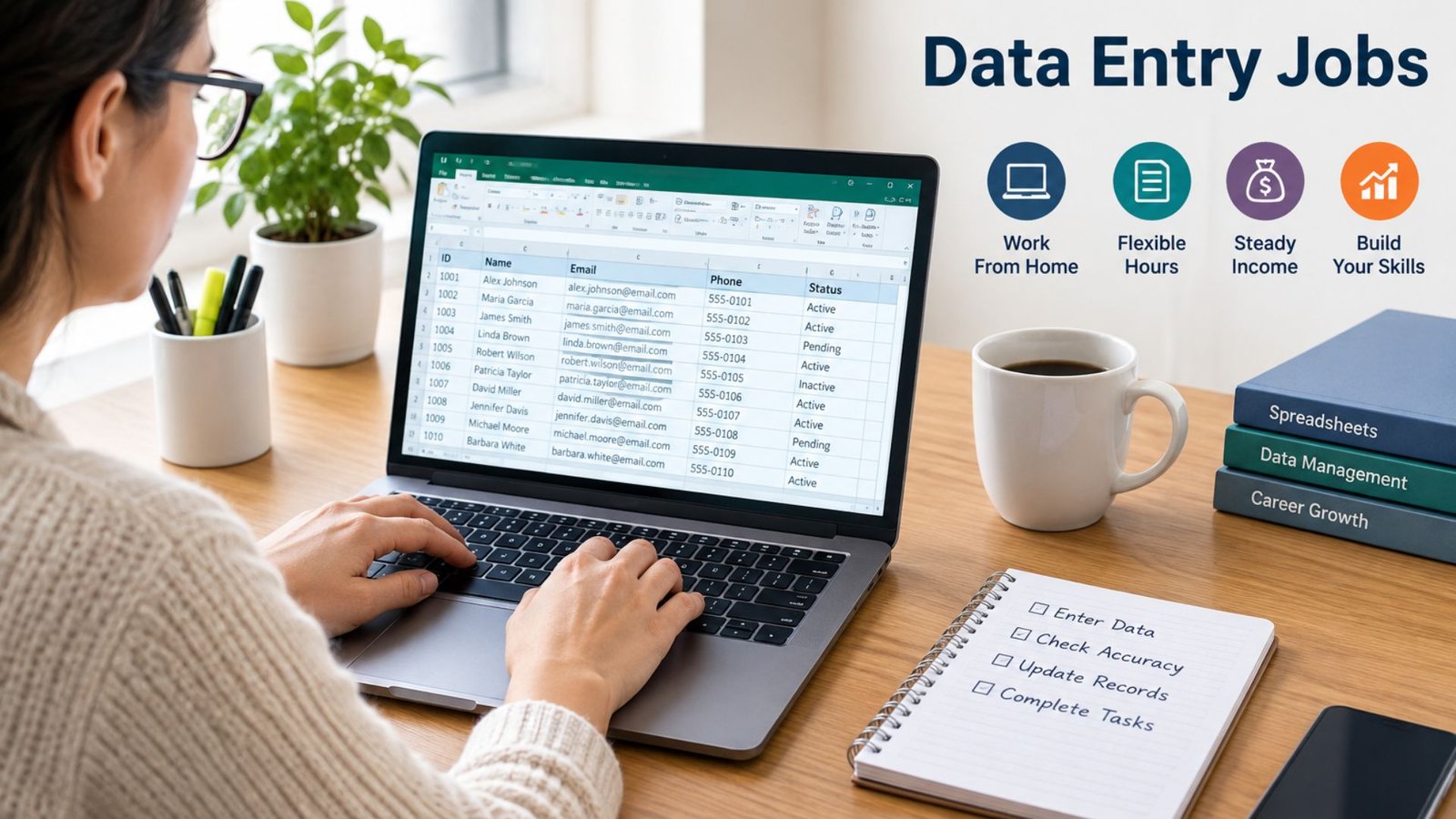
Data entry work remains an accessible starting point for people who are comfortable using computers, handling repetitive tasks, and checking information carefully. Data entry jobs can involve entering customer details, updating spreadsheets, processing forms, maintaining databases, or transferring information between digital systems.
For job seekers in the USA and UK, the role can appear under several titles, including data entry clerk, data entry keyer, information processing clerk, administrative assistant, records clerk, and database assistant. The exact responsibilities vary considerably by employer, so reading the full job description matters more than relying on the title alone.
What Are Data Entry Jobs?
At their core, data entry jobs involve recording, updating, organizing, or verifying information in a computer system. The source material might be paper documents, online forms, invoices, customer records, survey responses, inventory information, or internal business files.
Typical responsibilities include:
- Entering information into spreadsheets or databases
- Checking records for missing or incorrect details
- Updating existing customer or company information
- Converting information from one format to another
- Organizing digital files and records
- Using spreadsheets, databases, or specialized software
- Following confidentiality and data-handling procedures
The work is often detail-oriented rather than highly technical. Accuracy matters because a small typing or transcription error can affect reports, customer records, invoices, or business decisions.
In the United States, the Bureau of Labor Statistics classifies data entry keyers separately and reports that the occupation typically requires a high school diploma or equivalent, no related work experience, and short-term on-the-job training.
What Skills Do You Need?
You do not necessarily need an advanced degree to pursue data entry jobs, but employers commonly look for practical computer and organizational abilities.
| Skill | Why Employers Value It |
|---|---|
| Typing accuracy | Reduces errors during repetitive entry |
| Attention to detail | Helps identify missing or inconsistent information |
| Spreadsheet skills | Useful for sorting, organizing, and checking records |
| Basic computer literacy | Supports everyday digital workflows |
| Time management | Helps complete assigned workloads on schedule |
| Written communication | Useful for records, notes, and workplace messages |
| Confidentiality | Important when handling customer or business information |
Microsoft Excel or Google Sheets skills can be particularly useful. Knowing how to sort and filter information, format cells, use basic formulas, and locate duplicate or missing entries can make your application stronger.
Employers may also value transferable skills gained through education, volunteering, administration, customer service, or other work. UK careers guidance notes that digital proficiency, organization, communication, and problem-solving can help candidates demonstrate relevant transferable abilities even without extensive professional experience.
Are Remote Data Entry Jobs Available?
Remote work is one reason people search for data entry jobs online. Some businesses do employ people who work from home, but remote listings should be evaluated carefully.
A genuine remote position should normally provide clear information about the employer, responsibilities, compensation structure, application process, and employment or contract terms. The job should also have a verifiable connection to the company advertising it.
The Federal Trade Commission warns that scammers sometimes impersonate legitimate companies when advertising remote data entry and administrative positions. Fake recruiters may request financial information, send fraudulent checks, or ask applicants to pay for equipment or training.
💡 Pro Tip:
Before applying for a remote role, open the company’s official website independently and check its careers page. If the advertised vacancy cannot be verified through a credible company source, pause before sharing personal information.
How Much Can You Earn?
Pay for data entry jobs varies according to location, industry, experience, employer, working arrangement, and the actual responsibilities of the position.
For the USA, the latest BLS occupational data available in September 2026 lists 2025 employment of 131,800 data entry keyers and a May 2025 median annual wage of $41,340. The same data projects employment for data entry keyers to decline from 2025 to 2035, although openings can still occur as workers leave or change occupations.
These figures describe the specific U.S. data entry keyer occupation, not every job advertised online under a data-entry-related title. A role that combines data entry with customer service, bookkeeping, administration, research, or specialized industry knowledge may have different pay.
In the UK, compensation also depends heavily on the employer and role. Administrative positions can cover a broad range of responsibilities, and UK career guidance recommends comparing salary, conditions, job requirements, and progression opportunities rather than focusing on a job title alone.
Where to Find Legitimate Opportunities
When searching for data entry jobs, use established employment platforms, company career pages, recruitment agencies, and government-supported career resources where available.
Useful search terms include:
- Data entry clerk
- Data entry keyer
- Data processing clerk
- Records clerk
- Administrative assistant
- Information processing clerk
- Database assistant
- Remote data entry clerk
- Temporary data entry clerk
Don’t limit your search to one exact phrase. Companies frequently combine data entry with administrative, customer service, operations, finance, healthcare, or records-management duties.
UK job-seeking guidance recommends using job boards, recruitment agencies, employer websites, and job alerts while carefully reviewing each vacancy’s responsibilities and requirements.
How to Get Data Entry Jobs With No Experience
Entry-level data entry jobs can be approached strategically even when your employment history is limited.
Start by building a simple, professional résumé that emphasizes computer literacy, accuracy, organization, typing, spreadsheet knowledge, and any experience involving records or documentation.
If you have no formal data-entry background, create evidence of your skills. For example, you can practice entering sample information into Excel or Google Sheets, organizing a mock customer database, or cleaning a small dataset. These exercises can help you become more comfortable with the tools used in office environments.
Your application should also be tailored to the vacancy. If an employer repeatedly mentions Excel, accuracy, document management, or database systems, make sure your résumé clearly addresses the skills you genuinely possess.
Avoid claiming experience you do not have. A straightforward application supported by real abilities is more useful than a résumé filled with vague technical terms.
How to Recognize Data Entry Job Scams
Scammers often target people searching for flexible online work. The FTC specifically warns about fake work-from-home offers involving data entry and similar tasks. Common warning signs include unusually high pay for minimal work, pressure to make an immediate decision, requests for upfront payments, and demands for sensitive information before the employer has been properly verified.
Be especially cautious if someone sends you a check and instructs you to purchase equipment, transfer part of the money, or send funds elsewhere. The FTC identifies this pattern as a fake-check scam.
A legitimate employer should not require you to pay money simply to receive a job. Research the company independently, verify the vacancy, and avoid sending sensitive financial or identity information until you have confirmed who you are dealing with.
What Is the Future of Data Entry Work?
Technology is changing routine administrative work. The U.S. BLS currently projects a decline in employment for data entry keyers through 2035, which means candidates may benefit from developing skills beyond basic typing and repetitive entry.
A useful strategy is to combine data-entry ability with adjacent skills such as Excel, customer support, bookkeeping, document management, data quality checking, or administrative coordination. These capabilities can make it easier to pursue a wider range of office and operations roles.
The goal does not have to be staying in a narrowly defined data-entry position forever. An entry-level role can provide experience with business software, workplace procedures, documentation, and information management that may support later career moves.
Frequently Asked Questions
Are data entry jobs good for beginners?
They can be suitable for beginners who have basic computer skills, strong attention to detail, and the ability to follow instructions. Some U.S. data entry keyer positions typically require only a high school diploma or equivalent and short-term on-the-job training. Requirements vary by employer and industry.
Can I work from home doing data entry?
Some legitimate remote positions exist, but not every online listing is genuine. Verify the employer through an independently located company website or careers page. Be cautious about offers involving upfront payments, unusually high earnings, fake checks, or requests for sensitive information before employment is verified.
What software should I learn for data entry?
Excel and Google Sheets are useful starting points because many office roles involve spreadsheets. You can also become familiar with database interfaces, document-management systems, and common office productivity tools. The specific software depends on the employer, so review job descriptions to identify recurring requirements.
Can I get a data entry job without experience?
Yes, some entry-level positions may accept candidates with limited professional experience, particularly when they can demonstrate accuracy, computer literacy, organization, and willingness to learn. Transferable skills from school, volunteering, administration, customer service, or other activities can also strengthen an application.
Are online data entry jobs legitimate?
Some are, but applicants should verify every opportunity carefully. The FTC has warned about scammers impersonating legitimate employers and advertising remote data-entry positions. Never pay upfront to obtain employment, and do not deposit an employer’s check and send money back as part of an equipment or payment arrangement.
📌 Key Takeaway:
The strongest approach to finding legitimate data entry jobs is to combine accurate computer work with practical spreadsheet skills, a targeted résumé, careful employer verification, and realistic expectations about pay and long-term demand.
Conclusion
Data entry jobs can provide an accessible route into office, administrative, and information-processing work, particularly for people developing their professional experience. The role requires more than fast typing: accuracy, organization, digital literacy, confidentiality, and consistency all matter.
For applicants in the USA and UK, the best opportunities are those with clearly defined responsibilities, verifiable employers, transparent compensation, and realistic requirements. Building skills in spreadsheets and related administrative tasks can also expand your options beyond basic data entry as your experience grows.
