

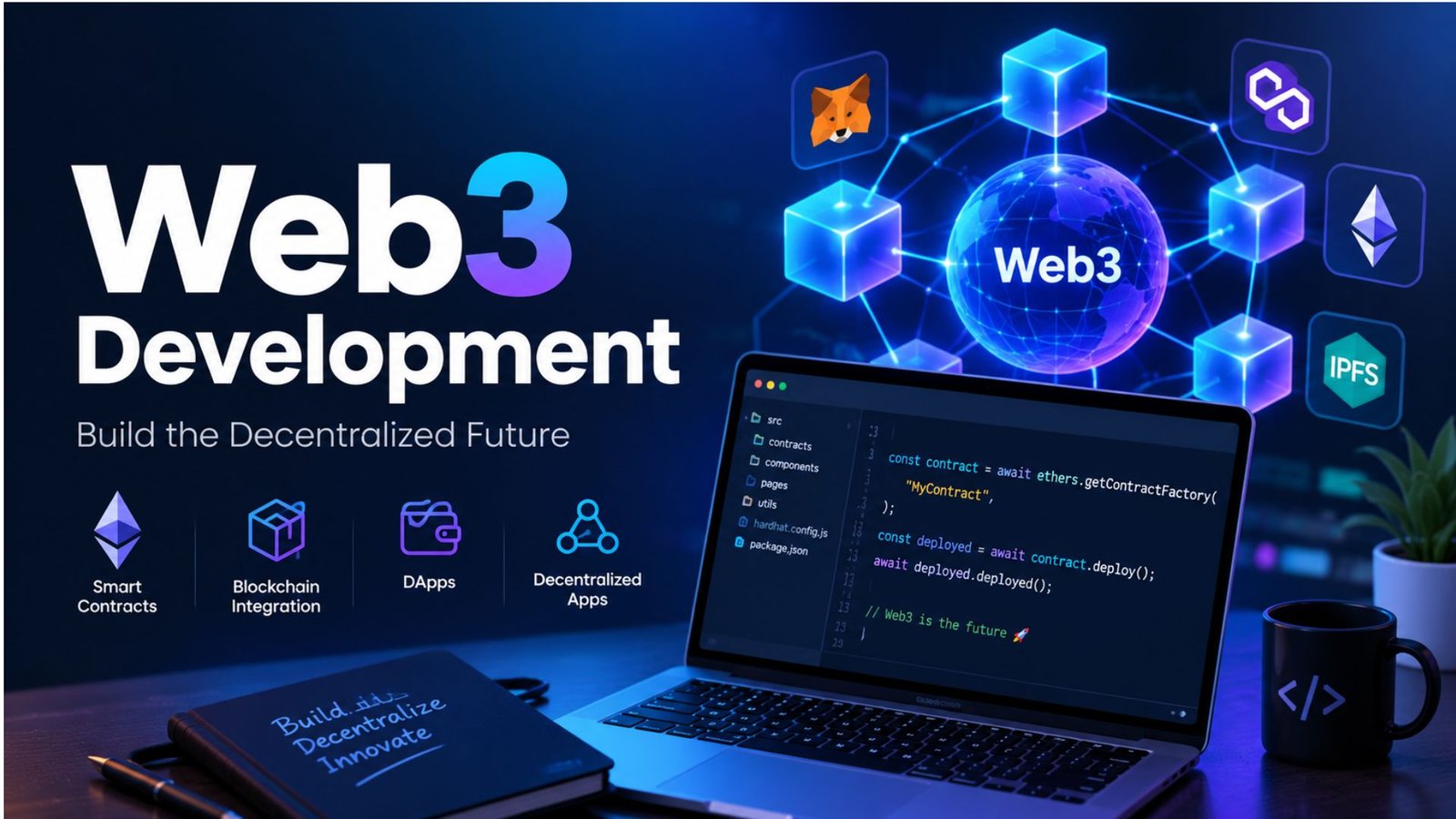
Web3 development focuses on creating decentralized applications and digital systems powered by blockchain technology, smart contracts, and distributed networks. Unlike traditional applications controlled by centralized companies, Web3 platforms allow users to interact with services while maintaining greater ownership of their data, assets, and digital identities.
Businesses, developers, and entrepreneurs are exploring web3 development to build solutions across finance, gaming, healthcare, supply chains, social platforms, and digital ownership. Understanding how this technology works, where it creates value, and what challenges it presents helps organizations make better decisions before investing in decentralized solutions.
What Is Web3 Development?
Web3 development is the process of designing and building applications that operate on blockchain networks rather than traditional centralized servers. These applications, commonly known as decentralized applications (dApps), use blockchain infrastructure to record transactions, manage digital assets, and execute automated agreements through smart contracts.
Traditional applications usually depend on databases controlled by a single organization. Web3 applications distribute information across a network of computers, reducing reliance on one central authority. Users typically connect through cryptocurrency wallets, which act as digital identities for accessing services and managing assets.
The core technologies behind this field include:
- Blockchain networks such as Ethereum, Solana, and Polygon
- Smart contracts for automated transactions
- Cryptocurrency wallets for user authentication
- Decentralized storage systems
- Token-based digital economies
- Cryptographic security mechanisms
How Web3 Applications Work
A Web3 application combines a traditional user interface with decentralized backend technologies. The front end may look similar to a regular website or mobile application, but the underlying processes work differently.
For example, a decentralized finance platform may allow users to exchange digital assets without relying on a traditional bank. Instead of a company approving each transaction manually, smart contracts automatically execute predefined rules stored on the blockchain.
Developers usually work with programming languages such as Solidity for Ethereum-based smart contracts, JavaScript or TypeScript for application interfaces, and specialized blockchain development tools for testing and deployment.
A typical workflow involves:
- Designing the user experience and application logic.
- Creating and testing smart contracts.
- Connecting the application with blockchain networks.
- Integrating wallets and authentication systems.
- Auditing security before public release.
Key Components of Web3 Development
Different technologies work together to create a functional decentralized ecosystem.
| Component | Purpose | Common Examples |
|---|---|---|
| Blockchain Network | Stores transactions and verifies activities | Ethereum, Solana, Polygon |
| Smart Contracts | Automates agreements and business logic | Solidity contracts, Rust-based contracts |
| Wallet Integration | Provides user identity and asset management | MetaMask, WalletConnect |
| Decentralized Storage | Stores data without relying on centralized servers | IPFS, Filecoin |
| Front-End Frameworks | Creates user-facing applications | React, Next.js, Vue |
Each component requires careful planning because security, performance, and user experience directly affect the success of a decentralized application.
Benefits of Building With Web3 Technology
Organizations are adopting decentralized technologies because they offer new possibilities that traditional systems often cannot provide.
Greater User Ownership
Web3 platforms allow users to maintain control over digital assets and identities. Instead of accounts being entirely controlled by companies, blockchain-based systems can give individuals ownership of their information and transactions.
Improved Transparency
Blockchain records are publicly verifiable, making transaction histories easier to audit. This transparency is valuable in industries such as finance, logistics, and digital marketplaces.
New Business Models
Companies can create token-based ecosystems, digital ownership systems, and community-driven platforms. Non-fungible tokens (NFTs), decentralized finance applications, and blockchain gaming demonstrate how ownership models can change through decentralized technology.
Reduced Dependence on Intermediaries
Smart contracts can automate processes that previously required third-party approval. This can reduce operational complexity and enable direct interactions between users.
💡 Pro Tip:
Businesses planning a Web3 project should begin with a clear problem statement instead of choosing blockchain simply because it is a popular technology. A decentralized approach creates value when transparency, ownership, or automated trust is genuinely required.
Popular Use Cases of Web3 Development
Web3 technology is expanding into several industries, although adoption levels vary.
Decentralized Finance (DeFi)
DeFi applications provide financial services such as lending, borrowing, and trading through blockchain networks. These platforms use smart contracts instead of traditional financial intermediaries.
Gaming and Digital Ownership
Blockchain gaming allows players to own digital items that can potentially move between platforms. This changes the traditional model where in-game assets remain controlled by game publishers.
Supply Chain Management
Companies can use blockchain records to improve product tracking and verification. A transparent ledger can help businesses monitor movement from manufacturing to final delivery.
Digital Identity
Decentralized identity solutions aim to give individuals more control over authentication and personal information while reducing dependence on centralized identity providers.
Challenges Developers Face in Web3 Projects
Although decentralized technology creates new opportunities, it also introduces technical and business challenges.
Security Risks
Smart contract vulnerabilities can lead to significant losses because blockchain transactions are often irreversible. Professional auditing and secure coding practices are essential.
Scalability Issues
Some blockchain networks face limitations related to transaction speed and fees. Developers often need layer-2 solutions or alternative networks to improve performance.
User Experience Problems
Many Web3 applications require users to understand wallets, private keys, and blockchain transactions. Simplifying these experiences remains a major focus for developers.
Regulatory Uncertainty
Governments worldwide are still developing policies around cryptocurrencies, digital assets, and decentralized platforms. Businesses must consider legal requirements before launching blockchain-based products.
Skills Needed for Web3 Developers
A successful Web3 developer usually combines traditional software engineering skills with blockchain knowledge.
Important skills include:
- Blockchain architecture understanding
- Smart contract programming
- Cryptography basics
- Front-end and backend development
- API integration
- Security testing
- Knowledge of decentralized protocols
Developers who already understand modern web technologies can often transition into Web3 by learning blockchain-specific tools and programming concepts.
The Future of Web3 Development
The future of web3 development will likely focus on improving usability, scalability, and real-world adoption. Early blockchain applications often prioritized experimentation, but newer projects are concentrating on practical solutions for businesses and everyday users.
Advancements in layer-2 networks, improved wallet experiences, and stronger security standards may help decentralized applications become more accessible. However, successful adoption will depend on whether these systems solve meaningful problems better than existing alternatives.
📌 Key Takeaway:
Web3 development is not simply about creating blockchain-based applications. Its real value comes from designing secure, transparent, and user-focused systems where decentralization provides a clear advantage.
Frequently Asked Questions
What is Web3 development used for?
Web3 development is used to create decentralized applications, blockchain-based financial services, digital ownership platforms, gaming ecosystems, identity solutions, and transparent business systems. Its purpose is to enable applications where users can interact with digital services through decentralized networks rather than relying entirely on centralized providers.
Is Web3 development difficult to learn?
Web3 development can be challenging because it combines traditional programming with blockchain concepts, cryptography, and smart contract security. Developers with experience in languages like JavaScript, Python, or other programming environments may find the transition easier by gradually learning blockchain tools and decentralized application architecture.
Which programming languages are used in Web3 development?
Common languages include Solidity for Ethereum smart contracts, Rust for some blockchain platforms, JavaScript and TypeScript for front-end applications, and Python for blockchain-related tools and automation. The best language depends on the blockchain network and project requirements.
Are Web3 applications secure?
Web3 applications can provide strong security through blockchain technology, but they are not automatically secure. Poorly written smart contracts, weak wallet management, and coding mistakes can create vulnerabilities. Security audits, testing, and professional development practices are necessary for reliable applications.
Will Web3 replace traditional applications?
Web3 is unlikely to completely replace traditional applications. Instead, it will likely complement existing technologies by providing decentralized options for specific use cases involving ownership, transparency, and digital trust.
Conclusion
Web3 development is changing how digital platforms can be designed by introducing decentralized networks, programmable agreements, and new models of ownership. While challenges around security, scalability, and usability remain, the technology continues to create opportunities for businesses and developers exploring the next generation of internet applications.
Organizations that focus on practical problems rather than technology trends will be better positioned to benefit from decentralized solutions. The strongest Web3 projects will combine reliable engineering, thoughtful user experiences, and meaningful real-world value.
